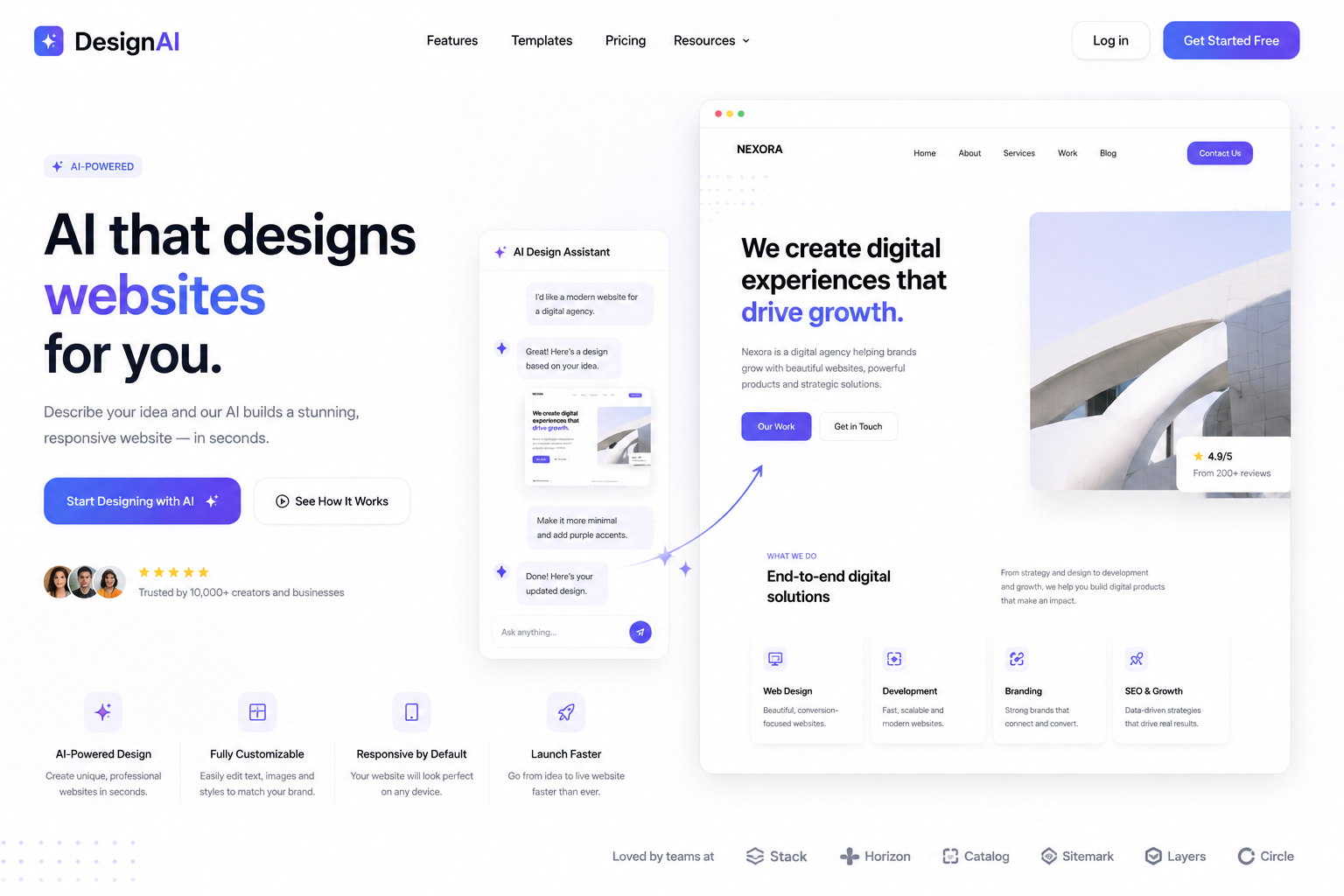
Artificial intelligence is changing the way websites are designed, built and maintained. What once required several specialists working across design, content, development and testing can now be supported by intelligent tools that help teams move from an idea to a working website much faster.
This does not mean web designers are becoming unnecessary. Instead, the role of the designer is changing. AI is taking over more of the repetitive work, while people are spending more time making decisions about usability, branding, customer needs and the overall experience.
Faster Design and Development
One of the clearest benefits of AI in web design is speed.
A designer can now describe the type of website they want and receive suggestions for layouts, colour schemes, page structures and content within minutes. Developers can also use AI coding tools to create components, troubleshoot errors and turn designs into working interfaces.
For a small business, this can significantly reduce the amount of time needed to launch a website. A project that might previously have started with several days of wireframing and initial development can now have a working prototype much earlier.
The important difference is that the first version is no longer the hardest part to create. The real work increasingly becomes deciding what should be kept, changed or removed.
Web Design Is Becoming More Accessible
AI has also lowered the barrier to creating professional websites.
Someone without extensive coding experience can now build a landing page, portfolio or simple business website using AI assisted website builders. Business owners can describe their services, choose a style and receive a reasonably complete starting point without understanding HTML, CSS or JavaScript.
This is particularly useful for startups and smaller organisations that may not have the budget for a large design and development team.
However, easier access does not automatically result in better websites. AI can produce something that looks polished, but good design still requires an understanding of the people who will actually use the website.
Designers Can Spend More Time on the User Experience
A large part of web design involves repetitive work.
Resizing elements, creating variations, writing placeholder content, checking layouts, producing icons and making small adjustments can consume a surprising amount of time.
AI can help with many of these tasks.
This gives designers more opportunity to concentrate on questions that matter to users.
Can visitors quickly understand what the company does?
Can they find the information they need?
Is the navigation clear?
Does the website work properly on a mobile phone?
Can someone with a disability use it comfortably?
Does the website feel trustworthy?
These decisions require judgement and an understanding of human behaviour. AI can assist with them, but it should not be expected to make every decision on behalf of the designer.
Personalised Websites Are Becoming Easier to Build
Most traditional websites show almost every visitor the same experience.
AI makes it easier to change that.
A website can respond to behaviour, preferences, location, previous interactions or the stage a customer has reached in their journey. Two people visiting the same website could eventually see different recommendations, content or calls to action.
An online retailer might highlight products based on browsing behaviour. A travel website could suggest destinations based on previous searches. A software company could present different information to a technical user and a business decision maker.
Used carefully, this can make websites more relevant.
Used badly, it can make them feel intrusive.
Businesses therefore need to consider privacy, transparency and data protection when introducing AI driven personalisation.
Content Creation Has Become Part of the Design Process
Design and content have always been closely connected.
A beautiful page can still fail if the message is unclear.
AI tools can help designers generate headlines, product descriptions, FAQs, calls to action, image ideas and alternative versions of existing content. This is useful because designers no longer have to rely entirely on placeholder text while building a page.
They can see how realistic content will fit within the design much earlier.
The danger is that businesses may publish generated content without reviewing it properly.
AI generated writing can sound repetitive, make inaccurate claims or fail to reflect the personality of a business. Content therefore still needs human review, especially when the website represents a company's brand.
AI Is Changing How Websites Are Tested
Testing is another area where AI is becoming increasingly useful.
Web teams can use intelligent tools to identify broken links, inconsistent layouts, accessibility problems, performance issues and unusual behaviour.
AI can also help developers understand error messages, create test cases and analyse code for potential problems.
This can make quality assurance faster, but automated testing should not completely replace people.
A system may confirm that a button works technically, while a person may notice that the button is difficult to find or that its wording is confusing.
Good testing needs both perspectives.
Accessibility Could Improve
AI has the potential to make accessibility a more natural part of the web design process.
Designers can receive suggestions about colour contrast, labels, keyboard navigation, image descriptions and page structure while they are working.
Developers can also use automated tools to identify some accessibility issues before a website is released.
This is valuable because accessibility is often treated as something to check at the end of a project. AI can help move those checks much earlier into the design and development process.
Still, accessibility cannot be reduced to a score from an automated tool. Real users experience websites in ways that automated systems cannot always predict.
Websites May Become More Interactive
AI is also changing what people expect websites to do.
Visitors are becoming accustomed to asking questions instead of searching through menus.
A customer visiting a care provider's website, for example, might eventually ask:
"Do you provide residential dementia care?"
"How much does it cost?"
"Can I arrange a visit next week?"
Instead of reading several pages, the visitor could receive a direct answer and continue the conversation through an intelligent website assistant.
This could gradually change the structure of websites themselves. Navigation menus and search boxes will remain useful, but conversational interfaces may become another common way of finding information.
The Risk of Websites Looking the Same
There is also a downside to the widespread use of AI generated design.
If thousands of businesses use similar prompts and tools, websites can begin to look remarkably similar.
The same rounded cards, large headings, gradient backgrounds, stock illustrations and familiar page structures appear again and again.
Good web design therefore needs more than generating an attractive interface.
Businesses will need stronger brand identities, original photography, thoughtful content and distinctive customer experiences if they want to stand out.
AI can generate options, but originality still depends heavily on human direction.
The Designer's Role Is Changing
The future web designer may spend less time manually creating every element from scratch.
Instead, designers are likely to spend more time directing systems, evaluating ideas and refining results.
Knowing how to ask the right questions will become increasingly valuable.
A designer might use AI to generate five possible layouts, then use their own experience to decide which one best supports the customer's objectives.
A developer might ask an AI coding assistant to create a component, then review the code for security, performance and maintainability.
The skill is moving from simply creating everything manually to knowing what good work looks like and being able to guide the technology towards it.
AI Will Not Replace the Need for Good Web Design
AI can build pages quickly.
It can write code.
It can create images.
It can suggest colours.
It can generate content.
It can analyse user behaviour.
But it cannot automatically understand every business, customer or situation.
A successful website still needs clear objectives, thoughtful decisions and an understanding of the people using it.
The strongest web design teams will therefore not be those that ignore AI or those that allow AI to make every decision. They will be the teams that know where AI saves time and where human judgement matters more.
Conclusion
AI is not simply another web design tool. It is changing the entire process of creating digital experiences.
Websites can now be designed, developed, tested and improved faster than before. Smaller businesses have access to capabilities that once required much larger budgets, while experienced designers and developers can automate routine work and concentrate on more valuable problems.
At the same time, speed should not become the only measure of success.
A website still needs to be useful, accessible, trustworthy, memorable and easy to understand.
AI can help create the website.
People still have to decide what makes it worth visiting.